Fascinating Facts About The Maasai People of Kenya: Culture, Traditions, History & Fascinating Facts
The Maasais of Kenya
Few communities are as closely associated with East Africa as the Maasai.
Their distinctive red shúkà, elaborate beadwork, pastoral lifestyle and energetic jumping dance have become familiar images around the world. Yet behind these recognisable symbols is a much deeper culture shaped by language, family, age, livestock, oral history, spirituality, land and community.
The Maasai are a Maa-speaking people whose communities are found in Kenya and northern Tanzania. In Kenya, Maasai communities are particularly associated with parts of the southern and Rift Valley regions, including Narok and Kajiado.
Their cultural heritage is also closely connected to the landscapes where many visitors encounter them, including the Maasai Mara and the wider southern Kenya tourism circuit. Kenya's National Tourism Service specifically identifies Maasai cultural experiences as an important part of the country's cultural and heritage tourism.
But the Maasai are not simply a people of the safari era.
They are a living community whose traditions continue to change alongside education, modern employment, technology, conservation and new economic opportunities.
Understanding this distinction makes a visit to a Maasai community much more meaningful.
Their traditional way of life has historically centred heavily on livestock, particularly cattle, and on communal relationships surrounding livestock, family and land.
The term Maasai refers to the people, while Maa refers to their language and broader cultural identity.
Maasai communities exist on both sides of the Kenya-Tanzania border, meaning their cultural identity extends beyond modern national boundaries.
This is important because the Maasai cultural world predates the modern borders separating Kenya and Tanzania.
Important Maasai areas include parts of:
- Narok County
- Kajiado County
- Laikipia and surrounding areas
- The wider southern Kenya region
The Maasai Mara ecosystem is one of the best-known landscapes associated with Maasai communities.
The name itself reflects this connection: “Mara” comes from the Maa language and is commonly associated with the landscape's characteristic spotted appearance created by trees and shadows.
Today, Maasai communities live in both rural and increasingly urban environments. Some families continue pastoral activities while others participate in education, business, conservation, tourism, formal employment and other modern economic activities.
A Brief History of the Maasai
The history of the Maasai is primarily preserved through oral traditions, alongside archaeological, linguistic and historical research.
Like many African communities, the Maasai have transmitted knowledge through generations using storytelling, songs, ceremonies and the teachings of elders.
Their history includes periods of migration, territorial expansion, interaction with neighbouring communities and adaptation to changing environmental conditions.
The colonial period introduced major changes to Maasai land, movement and political structures.
Later, the creation of national parks, conservation areas and other land-use systems further changed how communities interacted with landscapes that had historically been used for livestock grazing.
This history helps explain an important feature of modern Maasai culture: adaptation.
The Maasai have preserved important cultural practices while simultaneously responding to education, changing land-use patterns, conservation, markets and modern government systems.
Maa: The Language of the Maasai
The Maasai speak Maa, a Nilotic language belonging to the Eastern Nilotic branch of the Nilo-Saharan language family.
Maa is more than a means of communication. Language carries cultural knowledge, history, names, stories and concepts about the community's relationship with people, animals and the environment.
Oral communication has traditionally played an important role in passing knowledge between generations.
This is one reason elders have historically held an important position within Maasai society.
Stories, advice, songs and discussions can communicate lessons that might otherwise be lost.
Why Are Cattle So Important to the Maasai?
Few subjects are more important to understanding traditional Maasai society than cattle.
Cattle have historically provided:
- Milk
- Meat
- Blood
- Hides
- Social wealth
- Livelihood
- Bridewealth
- A measure of household prosperity
But reducing cattle to simply an economic resource misses their cultural importance.
Livestock can represent identity, social relationships and responsibility.
The size and composition of a family's herd can influence its economic position, while cattle also play roles in ceremonies and social exchanges.
The relationship between people and livestock has therefore shaped the Maasai way of life for generations.
The Maasai and Pastoralism
Traditional Maasai pastoralism developed around the seasonal movement of livestock in search of pasture and water.
This way of life requires detailed knowledge of the environment.
Pastoralists need to understand:
- Where water can be found
- Which areas provide grazing
- Seasonal weather patterns
- Livestock health
- Local vegetation
- Wildlife movements
- Drought conditions
This environmental knowledge is one reason Maasai pastoral culture is closely connected with the landscape.
However, modern land ownership systems, settlement patterns, climate pressures, education and changing economic opportunities have transformed pastoralism in many communities.
Some Maasai households remain strongly pastoral, while others combine livestock keeping with farming, business, employment and other livelihoods.
The Maasai Age-Set System
One of the most fascinating aspects of traditional Maasai social organisation is the age-set system.
Rather than viewing society only through individual age, traditional Maasai organisation places people within age-based groups that progress through different stages of social responsibility.
The system traditionally helps organise:
- Social responsibilities
- Community relationships
- Leadership
- Military roles
- Ceremonial responsibilities
- Intergenerational relationships
The exact customs and terminology can vary between Maasai sections and communities.
This is important because there is no single identical Maasai experience everywhere.
Different Maasai groups may have variations in language use, ceremonies and social practices.
Who Are the Maasai Moran?
The term Moran is commonly used for Maasai young men associated with a traditional warrior stage of the age-set system.
Historically, morans had responsibilities connected to protecting communities and livestock.
The warrior identity has also become one of the most recognisable elements of Maasai culture.
However, it is important not to interpret the term simply through the modern Western meaning of “soldier.”
The traditional role existed within a much wider social system involving age, responsibility, initiation, community expectations and eventual transition into elderhood.
Today, the social meaning of the warrior stage continues to evolve.
The Famous Maasai Jumping Dance: Adumu
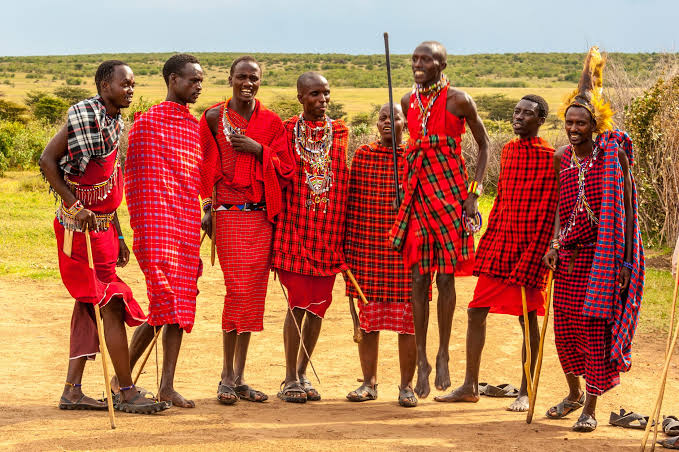
The Adumu is one of the most recognisable Maasai cultural performances.
Participants form a group while individuals or pairs enter the centre and perform vertical jumps while maintaining an upright posture.
The performance is accompanied by rhythmic singing.
It is often popularly described as a “warrior jumping dance,” but its cultural context is broader than a tourist spectacle.
The Adumu can be associated with ceremonies, celebrations and cultural presentations.
Kenya's National Tourism Service Portal identifies the Adumu as an important expression of Maasai cultural heritage and describes it as symbolising strength and unity.
Why Do Maasai Wear Red?
The bright red shúkà is perhaps the most recognisable item of Maasai clothing.
Red is strongly associated with Maasai visual identity.
However, Maasai clothing is not limited to red.
Different colours and patterns appear in clothing and beadwork, and their meanings can vary depending on context and community.
The colourful appearance of Maasai dress also reflects the importance of personal expression, social identity and cultural heritage.
Maasai Beadwork
Maasai beadwork is one of the most celebrated forms of traditional East African craftsmanship.
Women have traditionally played a central role in producing intricate beadwork.
Jewellery can include:
- Necklaces
- Bracelets
- Earrings
- Headpieces
- Belts
- Decorative ornaments
Beadwork can communicate aspects of identity, age, marital status and social position, although meanings can differ between communities and individual designs.
Today, beadwork also has an important economic dimension.
Many Maasai women participate in craft enterprises that allow traditional artistic skills to generate income.
This has made beadwork both a form of cultural expression and an important livelihood opportunity.
Kenya's tourism authorities specifically highlight Maasai beadwork as part of the country's cultural tourism experience.
What Are Maasai Traditional Homes Like?
Traditional Maasai homes are commonly associated with the manyatta, although terminology and settlement arrangements vary.
Traditional houses have often been constructed using locally available materials, with women traditionally playing an important role in construction.
A traditional homestead may include several households and livestock enclosures arranged according to local customs.
The design reflects the practical requirements of pastoral life and the importance of keeping families and livestock within a shared social environment.
Today, housing styles vary considerably.
Many Maasai families live in permanent modern houses, while traditional structures continue to be used in some communities for cultural, domestic or tourism purposes.
What Do the Maasai Eat?
Traditional Maasai food has historically been strongly influenced by pastoralism.
Important foods have included:
- Milk
- Meat
- Blood
- Grain-based foods
Milk has traditionally been an important source of nutrition.
However, the modern Maasai diet is not identical everywhere.
As communities have become more connected to towns, markets, farming and modern food systems, diets have diversified considerably.
This is another example of why it is misleading to describe the Maasai as living exactly as they did generations ago.
The Role of Women in Maasai Society
Women play fundamental roles within Maasai communities.
Traditional responsibilities have included:
- Raising children
- Building and maintaining homes
- Caring for households
- Processing milk
- Collecting water and firewood
- Producing beadwork
- Supporting livestock-related activities
Maasai women are also increasingly involved in education, business, conservation, tourism and community organisations.
Beadwork groups and women's enterprises have created opportunities for women to generate income while preserving artistic traditions.
The role of Maasai women today therefore extends well beyond traditional household responsibilities.
Elders and Community Wisdom
Elders traditionally hold an important position in Maasai society.
Their knowledge can include:
- Oral history
- Community customs
- Conflict resolution
- Livestock knowledge
- Environmental knowledge
- Ceremonial practices
- Social responsibilities
The importance of elders reflects the broader value placed on knowledge passed from one generation to another.
Storytelling is therefore not simply entertainment. It can be a way of preserving collective memory.
Maasai Spiritual Beliefs
Traditional Maasai spirituality centres around Enkai, commonly understood as the Maasai deity.
Beliefs and interpretations vary among individuals and communities, particularly as religious practices have changed over time.
Traditional Maasai beliefs have historically connected spiritual life with:
- Rain
- Livestock
- Fertility
- Well-being
- The natural environment
Today, Maasai communities include people with different religious beliefs, including Christianity, while elements of traditional cultural identity continue to remain important.
Maasai Music and Storytelling
Music is deeply connected to Maasai social and ceremonial life.
Traditional singing can involve groups responding rhythmically to a lead singer.
Songs may relate to:
- Ceremonies
- History
- Courtship
- Community identity
- Livestock
- Celebrations
Storytelling also provides a way for knowledge and values to pass between generations.
For visitors, experiencing Maasai singing in an authentic community setting can be considerably more meaningful when understood as part of a living cultural tradition rather than simply as entertainment.
The Maasai and Wildlife Conservation
The relationship between Maasai communities and wildlife is particularly important in southern Kenya.
Many Maasai communities live around some of Kenya's most important wildlife landscapes.
This creates both opportunities and challenges.
Livestock and wildlife can share landscapes, but they can also compete for:
- Water
- Grazing
- Space
Predators can also threaten livestock.
At the same time, tourism and conservation can provide communities with income, employment and other benefits.
Community conservancies have therefore become increasingly important in some Maasai areas, linking wildlife conservation with local livelihoods.
Kenya's tourism authorities specifically identify community engagement and sustainable development as important components of tourism in the southern and South Rift circuits.
Maasai Culture in Modern Kenya
Perhaps the most important thing to understand about the Maasai today is that tradition and modernity exist together.
Maasai communities increasingly participate in:
- Formal education
- Higher education
- Business
- Tourism
- Conservation
- Politics
- Professional employment
- Digital technology
Young Maasai may attend school, use smartphones, work in cities and participate in modern businesses while still maintaining strong connections to family, language and cultural identity.
Cultural change does not necessarily mean cultural disappearance.
In many cases, communities are deciding which traditions to preserve, which to adapt and which to leave behind.
Maasai Cultural Tourism in Kenya
For travellers, Maasai cultural experiences can provide an opportunity to learn about a living culture alongside a safari.
Cultural visits may include:
- Meeting community members
- Visiting a traditional homestead
- Learning about livestock
- Seeing beadwork
- Listening to traditional songs
- Learning about local history
- Experiencing cultural dances
- Purchasing locally produced crafts
The quality of the experience depends heavily on how the visit is organised.
A responsible cultural tour should ensure that local communities are active participants and beneficiaries, rather than treating culture simply as a performance for tourists.
Kenya's National Tourism Service Portal lists cultural and heritage tourism as an established tourism category and highlights community-based cultural experiences across the country.
How to Visit a Maasai Community Respectfully
Cultural tourism becomes more meaningful when visitors approach communities with curiosity and respect.
A responsible visitor should:
- Ask before taking photographs of people.
- Follow the guidance of local hosts.
- Listen rather than assume.
- Respect religious and ceremonial spaces.
- Purchase crafts directly from local artisans where possible.
- Avoid treating cultural practices as entertainment alone.
- Choose community-based experiences where benefits reach local residents.
- Avoid making sweeping assumptions about how all Maasai live.
Most importantly, remember that the people you meet are individuals, not attractions.
15 Fascinating Facts About the Maasai
1. The Maasai live in both Kenya and Tanzania.
Their cultural territory extends across the modern Kenya-Tanzania border.
2. Maa is their traditional language.
Maa belongs to the Eastern Nilotic language group.
3. Cattle are culturally significant.
Livestock have historically been central to Maasai livelihood, social relationships and cultural identity.
4. The Maasai are organised traditionally through age sets.
Age plays an important role in social responsibilities and progression through life stages.
5. Moran refers to a traditional warrior stage.
The role is part of a wider age-set system rather than simply a modern military occupation.
6. Adumu is the famous Maasai jumping performance.
It involves rhythmic singing and vertical jumping.
7. Beadwork is strongly associated with Maasai women.
Traditional beadwork has both cultural and economic importance.
8. The red shúkà is an important symbol of Maasai identity.
But Maasai clothing includes a much wider range of colours and designs.
9. Oral tradition is extremely important.
Stories, songs and knowledge have historically helped preserve cultural memory.
10. Maasai culture is not identical everywhere.
Different sections and communities can have different customs and practices.
11. Not every Maasai person is a pastoralist today.
Modern livelihoods include education, business, employment, conservation and tourism.
12. Maasai communities are closely associated with major wildlife landscapes.
Many communities live alongside or near important conservation areas.
13. Cultural tourism can support local livelihoods.
Beadwork, guiding, cultural visits and community enterprises can provide economic opportunities.
14. The Maasai continue to adapt.
Education, technology, changing land use and modern employment are reshaping contemporary Maasai life.
15. Maasai culture is a living culture.
Perhaps the most important fact is that Maasai traditions continue to evolve rather than simply exist as relics of the past.
Frequently Asked Questions About the Maasai
Who are the Maasai?
The Maasai are a Maa-speaking pastoral community living primarily in Kenya and northern Tanzania.
Where can I experience Maasai culture in Kenya?
Maasai cultural experiences are available in several areas of southern Kenya, particularly around Narok and Kajiado and near major safari destinations such as the Maasai Mara and Amboseli.
What language do the Maasai speak?
The traditional Maasai language is Maa. Many Maasai people also speak Swahili and, depending on education and location, English.
Why are cattle important to the Maasai?
Cattle have traditionally provided food and economic resources while also playing important roles in social relationships and cultural practices.
What is the Maasai jumping dance called?
The well-known jumping performance is called Adumu.
What is a Maasai warrior called?
A young man in the traditional warrior stage is commonly referred to as a Moran.
Do all Maasai people live traditionally?
No. Contemporary Maasai communities have diverse lifestyles. Some remain strongly pastoral while others combine traditional practices with education, employment, business, farming and other modern livelihoods.
Are the Maasai only found in Kenya?
No. Maasai communities are found in both Kenya and northern Tanzania.
What are Maasai women known for?
Maasai women have traditionally played major roles in household life and have become especially well known internationally for their intricate beadwork.
Can tourists visit Maasai villages?
Yes. Cultural tourism experiences can be arranged in several parts of Kenya. The best experiences are those organised with and benefiting local communities.
Experiencing Maasai Culture on a Kenya Safari
A Kenya safari does not have to be limited to wildlife.
A well-designed itinerary can combine wildlife viewing with meaningful cultural experiences.
For example:
Nairobi → Amboseli → Maasai Mara
can combine:
- Nairobi's urban culture
- Maasai cultural experiences
- Amboseli's wildlife and Mount Kilimanjaro scenery
- Maasai Mara's wildlife and community tourism
Another option is:
Nairobi → Maasai Mara → Lake Naivasha → Nairobi
with a cultural experience incorporated around the Mara region.
The ideal itinerary depends on the traveller's interests, available time and preferred accommodation.
The Maasai have become one of the most recognisable cultural communities in Africa, but their story is much richer than the images commonly seen in travel brochures.
Their heritage encompasses language, livestock, age-set organisation, music, storytelling, beadwork, clothing, spirituality, family and a deep relationship with the land.
At the same time, Maasai communities are participating in a rapidly changing Kenya.
Young people are pursuing education and careers. Women are building businesses. Communities are engaging in conservation and tourism. Traditional practices are being maintained, adapted or reinterpreted.
That combination of heritage and change is what makes Maasai culture fascinating today.
For travellers visiting Kenya, meeting Maasai community members can add an entirely different dimension to a safari: instead of simply seeing the landscapes where wildlife lives, visitors can begin to understand the people whose lives and histories are connected to those landscapes.
The Maasai are not simply part of Kenya's past. They are an important part of its present and its future.